
Patients Assessments
Intuitive, proximity-required tool for documenting patient assessments
ObservSMART equips staff with an intuitive, proximity-required tool for documenting patient assessments at the point of care—including depression, suicide risk, neurological, and detox scales—ensuring accuracy, compliance, and timely clinical insight.
Full EMR integration.
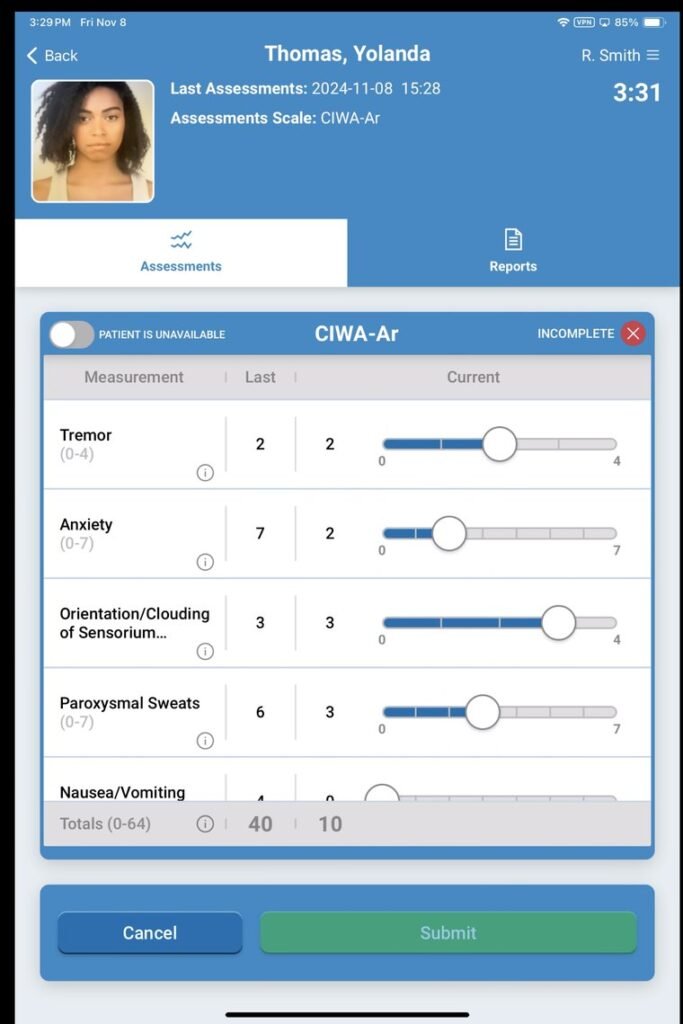
Examples include, but are not limited to:
-
CSSRS Screen Columbia-Suicide Severity Rating Scale
-
CIWA-Ar Clinical Institute Withdrawal Assessment Alcohol Scale Revised
-
Incontinence Check COWS Clinical Opiate Withdrawal Scale
-
Benzodiazepine Withdrawal Assessment Scale BWA
-
Stimulant Withdrawal Assessment Scale SWAS
-
Subjective Opioid Withdrawal Scale SOWS
-
Short Alcohol Withdrawal Scale SAWS
-
PHQ – 9 Patient Health Questionnaire
-
Morse Fall Scale
Customizable assessments to meet any needs.
Frequently Asked Questions (FAQs)
What is the ObservSMART Assessments module?
The ObservSMART Assessments Module enables clinicians to complete standardized assessments electronically at the bedside. It replaces paper forms with a streamlined digital workflow that improves consistency, supports care decisions, and ensures assessment data flows directly into the EMR.
How does the Assessment Module help with compliance and treatment planning?
The Assessments Module provides facilities with a consistent, time-stamped clinical record that supports compliance, audit readiness, and accurate documentation. Standardized assessment data helps improve care planning, track patient progress over time, and demonstrate the quality of care delivered. Data can also be viewed across all patients for population trend analysis.
Does the module support suicide risk and depression screening?
Yes. The Assessments Module includes established tools such as the PHQ-9 for depression screening and the C-SSRS Screen for suicide risk assessment, providing standardized scoring and clear risk categorization. The module also supports facility-specific and custom assessments, giving organizations the flexibility to meet their unique clinical, operational, and regulatory requirements.